
Shackelford County Civil Docket Searches
Begin with the court named on the petition, notice, or judgment. That is your Shackelford County civil case search. The combined District/County Clerk keeps district civil and family filings in Albany. Its page links to a Local Government Solutions records application. That application does not expose verifiable county fields. Treat the online link as a lead, not proof of a complete public name search.
The re:SearchTX portal opens a statewide electronic case-information route. Its official guide shows case, filing, document-text, and hearing views. Registration and document charges may apply. A result can point to a filing without granting free access to its image.
- Identify the court, party style, cause number, case type, and approximate filing date.
- Try the county LGS link, then re:SearchTX, and preserve the exact court and date shown in any match.
- For district civil or family records, contact the combined clerk at 325-762-9415 if the online tools fail.
- For small claims or eviction matters, call the countywide Justice of the Peace at 325-762-9430.
- Request the specific docket sheet, pleading, order, or certified judgment and confirm current charges before paying.
Shackelford Civil Cases Skip County Court
Here is the twist that trips people up. Under Texas Government Code §26.309, Shackelford County's constitutional County Court keeps only probate and juvenile jurisdiction, with no other civil or criminal authority at all. So a routine district civil or family case belongs to the 259th Judicial District Court, no matter how local it feels.
The 259th spans Jones and Shackelford Counties. Its coordinator sits in Anson and handles settings, while the combined clerk in Albany keeps the pleadings, party indexes, orders, and copies. Ask each office what it owns. That split matters when a hearing shows on a docket. You may still need the underlying motion.
| Civil matter | Shackelford starting court | Primary record route |
|---|---|---|
| District civil, title, divorce, family | 259th Judicial District Court | Combined District/County Clerk |
| Small claim within the state limit | Countywide Justice of the Peace | JP clerk |
| Eviction or forcible detainer | Countywide Justice of the Peace | JP clerk |
| Estate or probate | Constitutional County Court | Combined clerk and County Judge route |
Civil Dockets: What They Show
Think of a Shackelford County civil docket as a timeline. It lists each filing, notice, and hearing in order. It also gives the court, case category, filed date, judge, and current status where those fields are open to the public. It is not the whole case file. An entry may name an order or motion. The actual image costs a fee or is simply unavailable online.
| Court and location | The court assigned to the case and the county associated with the record. |
|---|---|
| Case category and type | The civil, family, probate, small-claim, or other classification used by the court. |
| Filed date | The date the clerk opened the matter or accepted a later filing. |
| Event history | Dated pleadings, motions, notices, orders, and other civil docket entries. |
| Hearing information | Public date, time, type, judge, or location information for a setting. |
| Case status | The current state of the matter, which must be read with the latest order or judgment. |
No live, readable Shackelford civil result exists to copy from. These fields come from official statewide interface materials, so resist inventing a local case-number format.
Shackelford Civil E-Filing Route
The eFileTexas active-court table lists Shackelford County. It shows full district, county, and probate search integration for the covered civil categories. Per the local probate page, new civil and probate filings go through eFileTexas. Attorneys typically work through an approved electronic filing service provider. Filers without a lawyer should ask the clerk which rule and method fit their document.
Remember that e-filing is not public docket access. An accepted envelope may feed the clerk's system. An image may stay restricted, sealed, redacted, or fee-based. The active-court table, likewise, only reports integration status. It returns no party results on its own. The official Shackelford OCA page supplies the local appointments and fees report index.
The local OCA report index serves an administrative purpose; it is not a named civil docket or party search.
What Cases Fill the Civil Docket
What actually fills the docket? The 259th District Court takes the Shackelford County civil and family work assigned to a Texas district court. That includes divorce, title disputes, and other district-level cases. The countywide JP handles smaller civil claims plus forcible entry and detainer matters. Government Code chapter 27 now caps justice-court civil jurisdiction at $20,000, exclusive of interest. An older county page still reads $10,000. Trust the current statute, and let the JP confirm the proper filing.
Probate is civil in a broad sense. Yet it runs through the constitutional County Court under a separate workflow. A standing order dated July 7, 2025 limits self-represented probate applications to a will and sole-heir setting. It bars pro se guardianships. Check the court before folding a probate search into an ordinary district civil lookup.
Family cases mix openness with restriction. A party name or setting may be public. An address, child-related detail, or filed image stays withheld. Keep those limits in mind when you read the results.
Shackelford Small-Claim Filing Trap
One local trap deserves a warning. The county JP page shows labels for Filing an Eviction and Filing a Small Claims Suit. Both links point to "#" instead of a downloadable form. The visible label proves nothing. Call Chief Clerk Melissa Hobbs or the JP office. Ask for the right document, the required attachments, the current fee, and the accepted filing method.
The same page also repeats the older $10,000 small-claim figure. Texas Government Code chapter 27 sets a $20,000 ceiling, exclusive of interest. The mismatch is a lesson in itself. Check any dated county instruction against current law and current clerk practice before making a Shackelford County filing.
Practical check: Confirm the current form and filing limit directly with the countywide JP before preparing a small claim or eviction packet.
Hearings on the Civil Docket
A setting on the Shackelford County civil docket tells you when the court plans to act. It might cover a motion, a conference, or a trial. The plan is not a promise. The case may not be tried that day. A later reset entry can swap in a new date while the suit itself stays alive. So read the setting type along with the latest order.
The 259th District Court sits in two counties. Confirming a date pays off. Santa Franco, the court coordinator, handles questions about district settings at 325-823-2721. For the record itself, the clerk in Albany is the contact. Before driving between counties, check the newest docket entry. Also check the coordinator's current calendar information.
- Setting
- A scheduled court event, which may be procedural rather than a final trial.
- Continuance
- A court-approved move of a hearing or trial to a later date.
- Reset
- A replacement setting entered after the prior date changes.
- Disposition
- The recorded way a claim or case was resolved, read with the final order.
Note: A moved date does not mean the civil case was dismissed or the motion withdrawn.
Shackelford Civil Copy Costs
Copy charges sit apart from any civil filing fee. The county's district fee page lists dated figures. These include Civil $272, Divorce $278, Other Family $262, plus several motion fees. Treat those numbers as a starting point. Confirm today's amount with the office. Copy fees for the district clerk, county clerk, probate, and sheriff service appear on separate pages and PDFs. Those carry different dates.
Texas Government Code chapter 51 sets the district-clerk copy framework. Local Government Code chapter 118 covers county-clerk copies and court papers. When you request a Shackelford County item, say whether you want a plain paper copy, an electronic copy, a certified copy, a search, issuance, or service. Each can carry a different charge. The official County Clerk fee page posts its own effective-date notice.
The dated source supports checking current copy and certification charges with the combined clerk.
Who Can See Civil Dockets
Most Shackelford County civil docket entries are public. Still, access has limits. Sealed filings, protected addresses, sensitive data, juvenile information, and some family material may be withheld or redacted. Texas Rule of Appellate Procedure 21c governs sensitive data in court filings. Family Code §85.007 lets a protective-order applicant ask that an address and telephone number stay out of the order and the public file.
You can reach civil court records several ways: LGS where functional, re:SearchTX where covered, in-person review at the Albany clerk counter, telephone, fax, email, or mail to P.O. Box 2109, Albany, TX 76430. The clerk keeps office hours Monday through Thursday, 8:30 a.m. to noon and 1:00 to 5:00 p.m. On Friday the noon break is the same. The office closes at 4:00 p.m.
Access boundary: The Texas Judicial Branch open-records policy directs case-record requests to the clerk that holds the file. Judicial records are not ordinary Texas Public Information Act requests.
Statewide search results help you locate the file. Certified civil records come from the originating clerk. For a focused request, give the court, the case style, the cause number when known, a date range, and the exact document you need. The Shackelford County docket search page can help you tell the online channels apart before you order a copy.
The county's duplicate clerk page confirms the combined local office route. That page shows the office handling every filing.
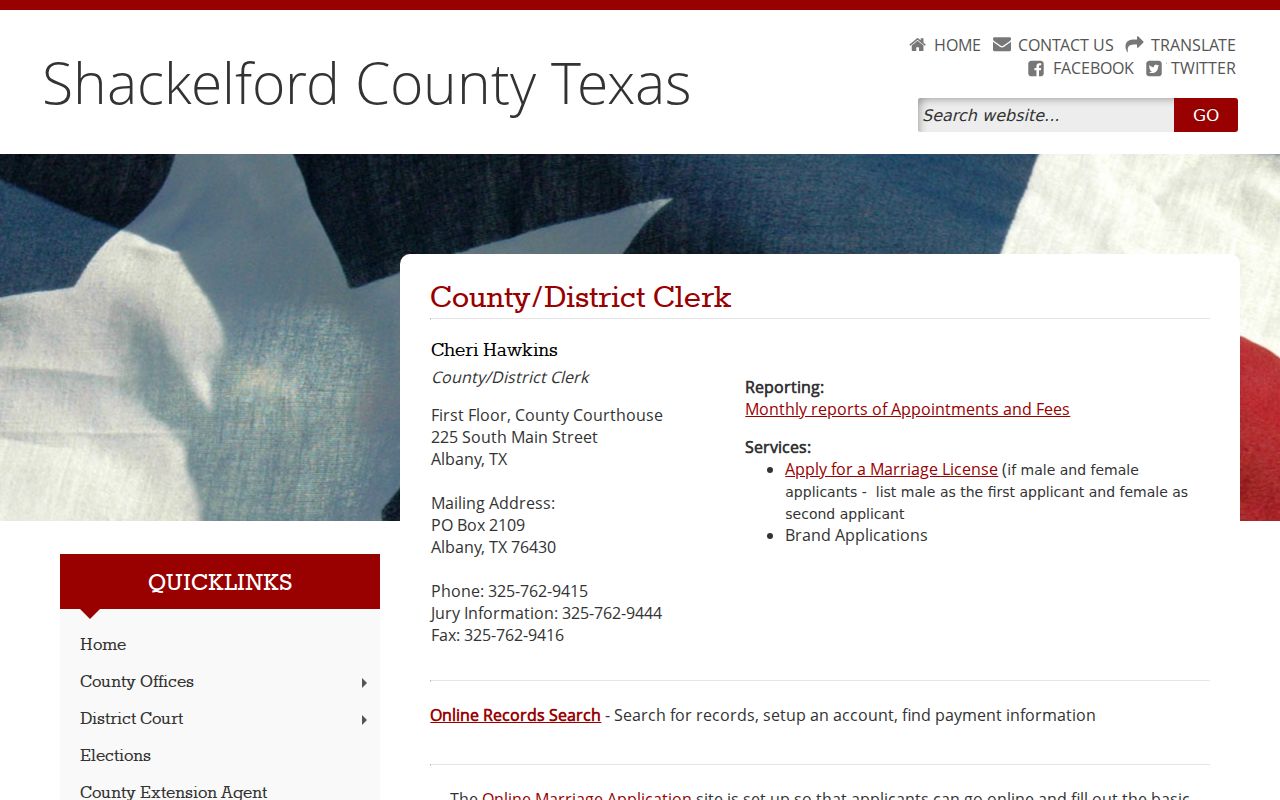
The official page still works well for confirming contacts, even where its labels blur district and county duties.
Shackelford Civil Activity in Context
Official OCA activity reports sum up court flow without naming litigants. The FY2023 countywide JP record counted 102 civil cases pending at the start, 33 added, 32 disposed, and 107 pending at the end. Those figures cover one report period. They cover one court category. They are not a party index. They also say nothing about the separate district civil docket.
Aggregate counts do show how small claims and eviction work moves through the one countywide JP. To find a specific suit, you need the cause number or case style. Then go to the JP clerk. No count can tell you whether a case is open, sealed, reset, or resolved.