
Shackelford County Criminal Docket Searches
Felony records in Shackelford County start with the combined District/County Clerk, the office that records the acts and proceedings of the District Court. The county page points to Local Government Solutions for an online records search. Treat that link with caution. The service loads as a bare application shell, with no visible county filters, result fields, fees, or document access until it runs in a normal browser, so a name or cause-number query may not work at all.
Match your route to the court named on the notice. The 259th Judicial District Court handles felonies. The countywide Justice of the Peace and the Albany Municipal Court handle fine-only matters within their authority. Juvenile records sit apart and need a restricted request.
- Read the citation, charging paper, bond paper, or notice and note the court, case number, and approximate date.
- Try the county LGS link for a public result, without assuming that every criminal case or image is online.
- Check re:SearchTX, but remember that state materials do not promise complete criminal coverage.
- Call the combined clerk at 325-762-9415 for a felony file, or the court named on a fine-only citation.
- Ask about inspection, copy charges, certification, payment, and any access limit before placing an order.
Shackelford Felony Records Split Towns
Shackelford County shares its felony court with a neighbor. The 259th Judicial District Court covers Jones and Shackelford Counties. Its judge and coordinator are listed with a mailing address in Anson. The clerk in Albany, though, holds the district filings for Shackelford. That split creates a simple two-office rule. Ask the coordinator about a setting; ask the clerk about a filed record. Neither office does the other's job.
So a Shackelford felony docket may sit in Albany. The person who can confirm the calendar works out of Anson. For a date, courtroom, or reset, call the coordinator at 325-823-2721. For a charging instrument, a judgment, or a certified copy, go to the clerk. The full Shackelford County docket search lays out how the county and statewide search layers differ.
The district court's own page posts the contacts and notices that affect settings.
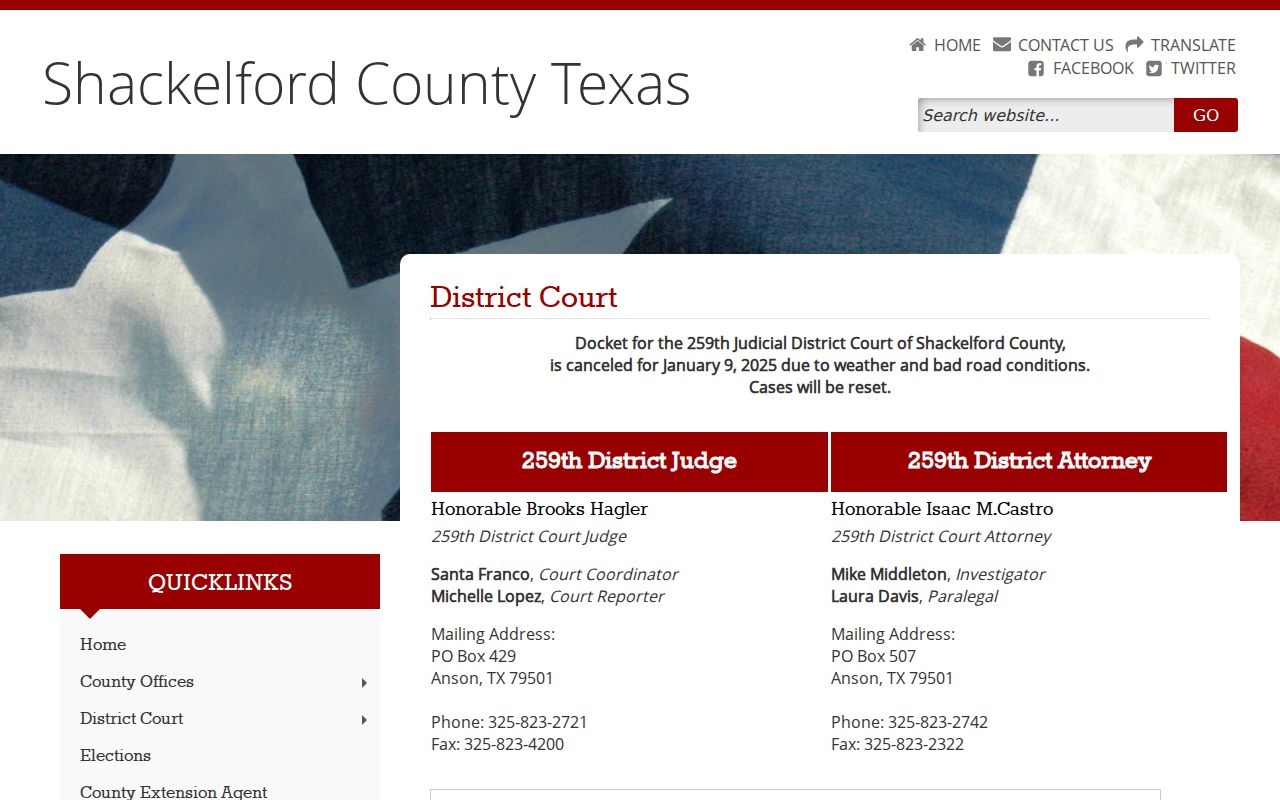
The capture reinforces why setting questions and case-file requests follow separate local contacts.
Criminal Dockets: What They Show
A public Shackelford County criminal docket is an event log, not the case file itself. Official re:SearchTX materials treat case details, filings, and hearings as separate views, and a local docket entry may point to a filing without showing the document image. The fields described here come from official state interface material and serve as a privacy-safe inventory of what a Shackelford criminal result can contain.
| Case identifier | The cause number assigned by the clerk; no local criminal format was verified, so do not infer one. |
|---|---|
| Court and category | The court location and case type that distinguish a felony from a fine-only matter. |
| Filed events | Filing dates, descriptions, notices, orders, and other entries posted to the event history. |
| Hearing setting | The date, time, and hearing type when those fields are released for public view. |
| Status and result | The current status and any public disposition or judgment entered by the court. |
Read every line as a dated entry. A setting is not a conviction, and an old charge line may not state the final result. Open the latest public judgment or disposition, then confirm it with the clerk when accuracy matters.
Shackelford Criminal Filing Technology
The eFileTexas active-court table lists Shackelford County with full district, county, and probate search integration. It also shows mandatory criminal filing. That is a statement about court technology. It does not make eFileTexas a public criminal docket index. It also does not mean a filed image is free to view. Filing and public inspection are separate tasks.
re:SearchTX is the statewide case-information layer. Its official guide shows Cases, Filings, Text in Documents, and Hearings, plus filters and saved searches. The OCA data report says the electronic-document set excludes criminal case records. So a blank Shackelford criminal result may reflect coverage or access limits. It may not mean the absence of a local case.
Portal gap: If LGS or re:SearchTX does not show the record, contact the originating clerk. Neither portal replaces the court file.
The official County Judge page documents the office tied to probate and juvenile work.
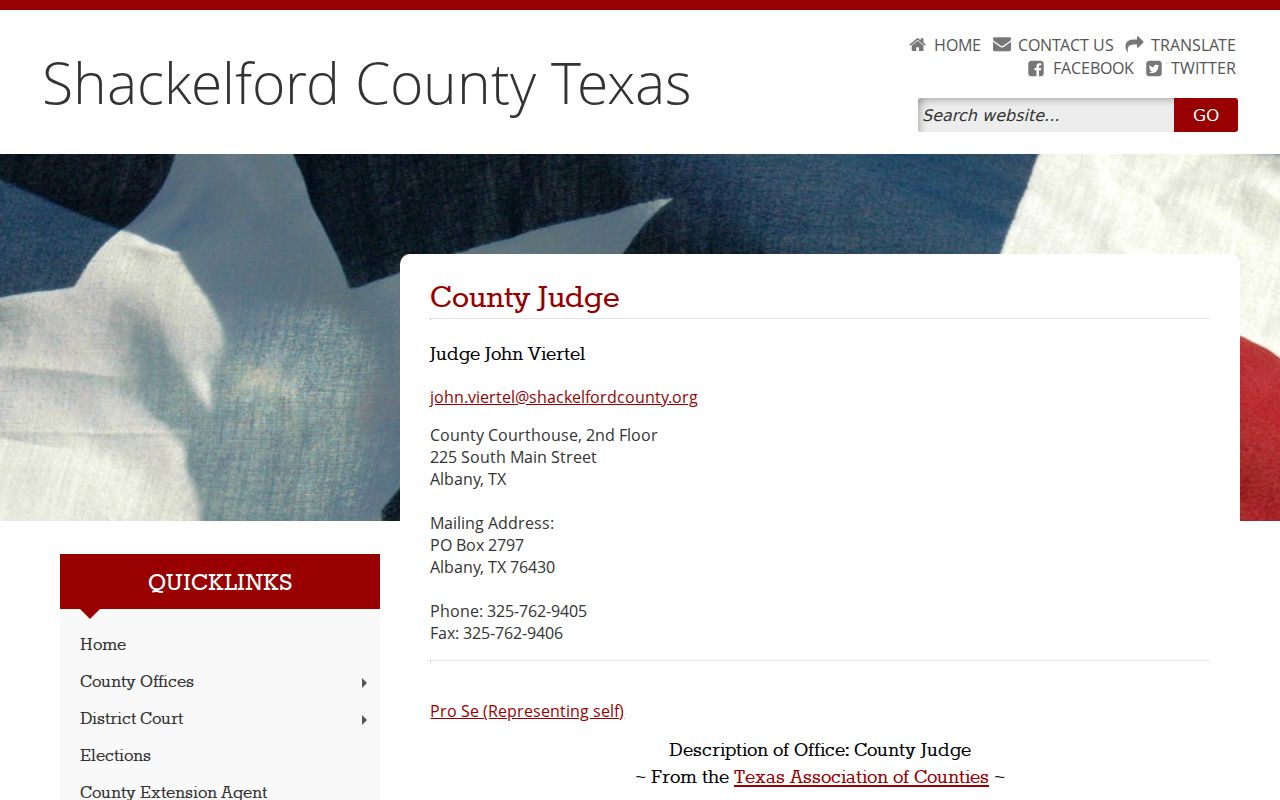
This source separates the county court's narrow juvenile role from the district felony docket.
Criminal Case Stages on the Docket
Felony entries on a Shackelford County docket trace the work of a Texas district criminal case. The clerk's filed charge starts the public sequence. Arraignment records the formal plea stage. Pretrial settings may cover discovery, motions, scheduling, or a plea, and a trial setting means something different from a pretrial date. The docket then records the court's disposition and, when applicable, sentencing.
Docket flow: Charge Filed › Arraignment › Pretrial Settings › Plea or Trial › Disposition › Sentencing
A reset moves a step in time; it does not erase the case. Read any deferred adjudication entry together with the later record. Texas Code of Criminal Procedure article 42A.106 addresses disclosure of deferred-adjudication information, but the public status still must be checked in the originating file.
Note: The latest dated order or judgment gives more context than an isolated charge or hearing entry.
Shackelford Criminal Court Boundaries
Texas court names can mislead a Shackelford County searcher. The 259th District Court holds felony jurisdiction. The constitutional County Court holds no ordinary criminal jurisdiction. Texas Government Code §26.309 gives it general probate and juvenile jurisdiction and nothing else civil or criminal. So a Class A or B misdemeanor should not be routed there just because other Texas counties use a county court for such matters.
| Matter | Local starting point | Record contact |
|---|---|---|
| Felony | 259th Judicial District Court | Combined clerk for filings; coordinator for settings |
| Fine-only county case | Countywide Justice of the Peace | JP clerk named on the citation |
| Albany ordinance or Class C case | Albany Municipal Court | Municipal court in the OCA directory |
| Juvenile matter | District or county role assigned by law | Clerk, subject to confidentiality |
The OCA directory lists no Moran municipal court. That is a reason to read the citation closely and ask Moran or the countywide JP directly. It is not proof that no city venue can exist.
Shackelford County Criminal Docket Courts
Start felony matters with the combined clerk in Albany. The office sits at 225 South Main Street, Albany, Texas 76430. Mail can go to P.O. Box 2109, Albany, TX 76430. Call 325-762-9415, fax 325-762-9416, or write to cheri.hawkins@shackelfordcounty.org as the OCA office report lists. Ask in advance whether a public terminal exists before you drive over.
Fine-only county cases usually begin in the countywide Justice Court at 309 South 2nd Street in Albany. Reach it at 325-762-9430. City violations belong to Albany Municipal Court. Match your request to the court, not to where the incident happened. Federal charges fall under the Northern District of Texas, Abilene Division. PACER holds those records rather than any state system. For costs, the county district-court fee page posts local amounts bearing dates of its own. So confirm the current figure with the clerk.
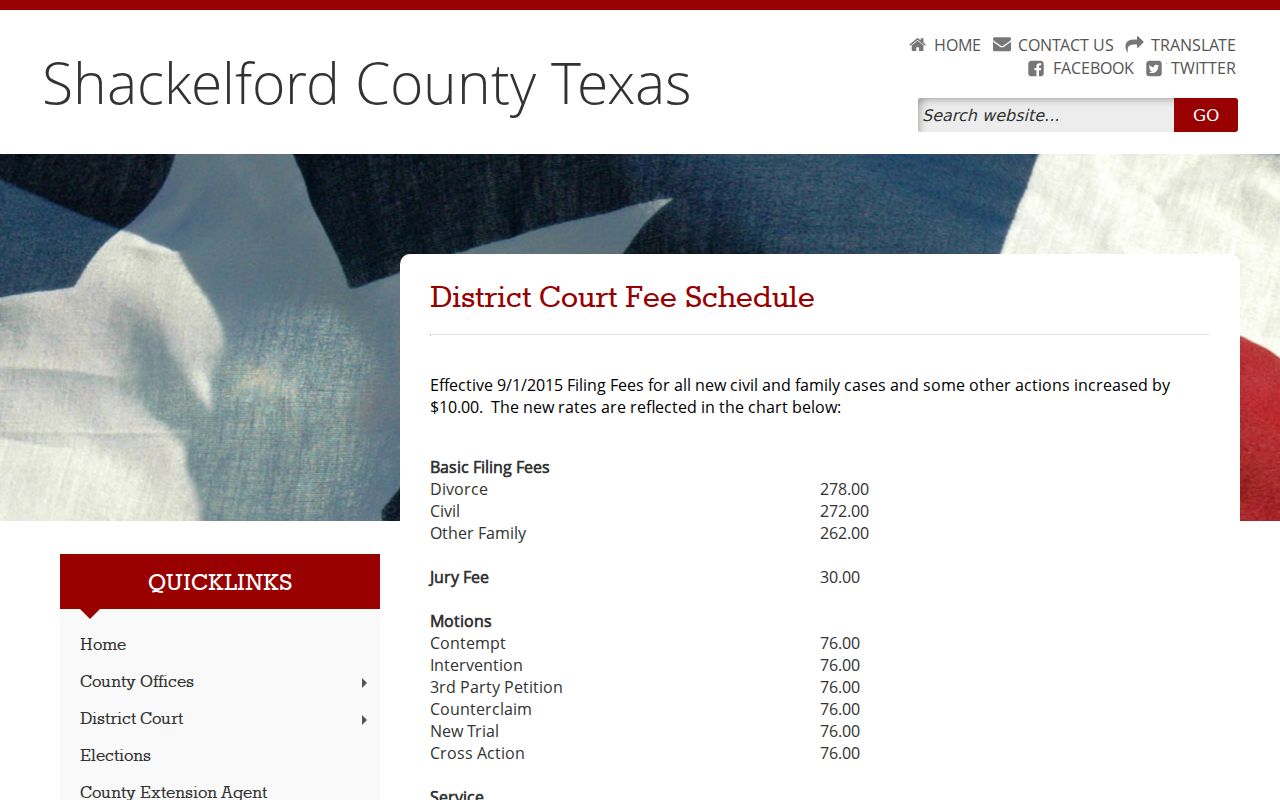
Those dated figures show exactly why a caller should confirm today's copy or filing cost with the clerk.
Shackelford Juvenile Docket Limits
Shackelford County handles juvenile matters, but nothing like felony access applies. Texas Family Code chapter 58 shields juvenile justice information from ordinary view. No portal will hand over names, party indexes, or file images. Not to a member of the public. A small county is not a looser county.
Ask the combined clerk which court holds the matter. Also ask whether you are entitled to the record at all. Where a public order or an aggregate count may be released, request that narrower item instead. The County Court does hold juvenile authority under Government Code §26.309. Even so, that authority does not turn its juvenile file into an ordinary public county criminal docket.
OCA aggregate activity reports can supply counts without exposing any child. They explain workload. Yet they cannot confirm a named matter. They cannot stand in for a lawful request either.
Access Rules for Criminal Dockets
Public Shackelford County criminal records live with the court that made them. The Texas Judicial Branch keeps no individual trial-court file. Nor does the Texas Public Information Act treat judicial case records the way it treats executive records. Instead, court rules, statutes, sealing orders, and clerk duties govern access.
Channels include LGS, re:SearchTX where covered, and the clerk's counter. Phone, fax, mail, and the OCA-listed email also work. Before relying on any channel, confirm a few things. Ask whether email or fax counts as an order, what payment is due, and whether an electronic or certified copy is available. No clerk can go around a seal or restriction.
Key access rules:
Texas Family Code chapter 58 protects juvenile justice information and limits access.
Texas Rule of Appellate Procedure 21c requires sensitive data to be omitted or redacted.
Texas judicial open-records policy sends case-record requests to the clerk that maintains them.
Searches, certified copies, and images may each carry their own fee. Local pages and PDFs bear different dates. Get a current quote from the clerk, since a portal price is not the certification fee.
Shackelford Criminal Activity Counts
OCA reports show Shackelford County aggregate court activity while protecting both defendants and juveniles. Take the FY2023 countywide justice-court record. There, 680 criminal cases were pending at the start, 107 were reactivated, and 877 were added. Another 793 were disposed, 190 went inactive, and 726 remained pending at the end. These are reporting-period counts. They are not a list of people or a statement of current case status.
The figures explain why a lower-court docket can carry heavy activity in a small county. Still, they cannot reveal whether a named case exists or how it ended. For that, go to the court and clerk holding the record.